Just a Little While to Stay Here
Bye and Bye
The Old Rugged Cross
Sometimes My Burden is Hard to Bear
Down By the Riverside
Just a Closer Walk With Thee
Lord, You've Been Good to Me
When the Saints Go Marching In
George Lewis * clarinet
Avery "Kid" Howard * trumpet
Jim Robinson * trombone
Alton Purnell * piano
Lawrence Marrero * banjo
Alcide "Slow Drag" Pavageau * bass
Joe Watkins * drums
While DownBeat and Time magazines were wondering what happened to the jazz clarinet in the 1950s, George Lewis was flying under their defective and underdeveloped radars, touring the globe and inspiring generations of imitators in Europe, Japan, Australia, Canada, and even here in the US. The professional jazz press, located mostly in New York and traditionally loathe (even to this day) to look beyond the nightclubs and fashions of that largest of provincial minded cities, simply ignored a vital, and global, trad jazz movement largely spurred by Lewis.
Lewis's story is one of perseverance like few others. He was virtually unnoticed for the first several decades of his musical career, working most of his professional life before his mid-forties as a longshoreman unloading coffee bags in New Orleans. His biggest 'early' break came when he got the call to join Bunk Johnson in NYC in 1945, where he got some notice during one of those rare "revivals" when traditional polyphonic New Orleans style jazz gets noticed in the Big Apple. He was already 45 years old and had been playing professionally since he was a teenager. After Bunk's death in 1949, the band continued under the name of George Lewis and His Ragtime Band.
For a bandleader with as many obstacles to his career as George Lewis, it is remarkable how many landmark, important recordings he made. At a time when jazz was becoming increasingly associated with heroin, anger, and esoteric musical language on the one hand, or tepid commercial sheen on the other, Lewis continued to plow the rough, fertile ground of spirituals, marches, and polyphony developed in his native city. Among those important recordings Jazz At Vespers ranks high.
That the recording happened at all was largely thanks to the Reverend Alvin Kershaw, then rector of Holy Trinity Episcopal Church in Oxford, Ohio, whose passion for and dedication to jazz was extraordinary. Around the time of this recording, Rev. Kershaw had gained a bit of national celebrity from appearances on The $64,000 Question (jazz was his chosen category) and on a Sunday religious program, Look Up and Live, where, according to the original album liner notes, he said "To worship properly, we should offer God all of ourselves, our feelings as well as our thoughts. Jazz, which appeals to our emotions, helps us to do this."
The notes to the album go on to say that Kershaw had brought the band to Holy Trinity once before the recording as well, for a Sunday service in 1953. He made it clear to a Cincinnati newspaper at the time that "jazz musicians playing spirituals...are an outgrowth of the suffering of their people [and] have something of universal truth to pass along to his more fortunate congregation." On February 21, 1954, because of a cancellation the band received elsewhere, Kershaw suggested the Lewis band take over the music for Holy Trinity's regular Sunday Vespers service, and this recording was the result.
The recording captures Lewis's ensemble perhaps at zenith. This was the band that had such a powerful impact upon the English trad jazz scene (which in many ways remains more organized and vibrant than the trad jazz community in the US). Monty Sunshine, Acker Bilk, Terry Lightfoot, and countless others imitated and learned from George Lewis, branching out creatively into their own styles afterwards; a young Ringo Starr heard the band and was awed by Joe Watkins's drumming (and once you hear Watkins, you can hear how deeply it impacted the future Beatle). The root of all this music is the spiritual, and the specific depth of uniting human emotion to praise and lamentation, communally. There are few recordings as important as this in jazz history. It does not feature virtuoso playing; it is pure ensemble. It's also something every jazz musician should experience and study.

Showing posts with label 1954. Show all posts
Showing posts with label 1954. Show all posts
Thursday, July 7, 2016
Tuesday, March 12, 2013
Edmond Hall Live at Club Hangover * 1954
Like 1938, the year of Benny Goodman's Carnegie Hall triumph and Artie Shaw's ascendancy to national prominence, the year 1954 is a major benchmark for jazz clarinet. Shaw's massive final recordings project took place during the first half of that year, ultimately overshadowing all other performances. But tucked away in that history, on August 7th and 14th, recordings were made of broadcasts from Club Hangover in San Francisco of the Ralph Sutton Quintet, with Edmond Hall on clarinet.
The recordings aren't ideal--neither the microphone placements nor the acoustics of the club are particularly inspiring, especially when compared to some of the great live jazz recordings from that era in venues such as the Village Vanguard or the Blue Note. But they are clean, and obviously of equal or better quality as the earlier swing era live checks from the Madhattan Room and elsewhere.
Considering those Edmond Hall served with as a sideman (he was Louis Armstrong's go-to clarinetist for years) and the pianists he'd recorded with (Teddy Wilson and Eddie Heywood among others), this group is much more humble. Ralph Sutton was a solid jazz pianist of the old stride school, and Clyde Hurley a very good trumpet man--all the players on these dates were the "real deal" among musicians--but it would have been impossible for even excellent players to rival the legends on Hall's resume.
Having said this, jazz is not like classical music. The best recordings are not invariably done by the top technical players, and the music, being an exercise in active, communal creativity rather than primarily concerned with reproducing someone else's musical thought, cannot always be well judged by personnel. Armstrong himself often worked with inferior sidemen, as did Sidney Bechet. Shaw and Goodman's recordings are filled with performances by sidemen who never sounded as good afterwards--they were often lifted to greatness by those around them. Duke Ellington's band, despite having brilliant players like Johnny Hodges, Ben Webster, and many others, was always more than the sum of it's parts technically.
Like great basketball players, jazz musicians are often best judged by how they improve the players around them. That this recording provides such a good example makes it indispensable. In many ways, it strikes the listener as an average professional jazz gig from 1954--and therefore a valuable contrast to the pellucid masterpieces of the Shaw Gramercy 5 recorded only months earlier. The gigs contain a laundry list of war horses still on bandstands today: 'St Louis Blues', ' I Got Rhythm', 'Honeysuckle Rose', 'Between the Devil and the Deep Blue Sea', and more. The style is a loose, natural fusion of swing, New Orleans, and boogie woogie--a type of lingua franca, catch all "jazz" style for that era (soon, this style would be considered 'traditional', as bop and other aspects of modern jazz entered the mainstream). Edmond Hall is such a powerful presence on these numbers that he seems the musical leader of the group, though because of his firm New Orleans roots, is so committed to ensemble that he stays within the groups parameters, lifting the level of inspired play for all. Clyde Hurley's trumpet solo on 'Black and Blue', for instance, delivers such powerful soul tonally, that the listener doesn't care who is playing or where: we're just grateful.
Edmond's sound is not well captured here. There are many potential reasons for this, ranging from poor microphone placement to a bad reed. But it doesn't matter. In fact, it's probably better that he doesn't sound anywhere near his best self on this recording: we get to hear what a musician like Hall can accomplish in less than perfect conditions.
This recording is one of my personal favorites. The sound isn't great, but in some ways it's more honest than studio recordings are--and getting to that level of reality can become addictive in it's own way. In fact, it was because of recordings like this that I decided to release our 'Bootlegs from the Bop Stop' CD last year, so you could say that this album had a permanent impact not only on my playing, but my conception of what makes a great album.
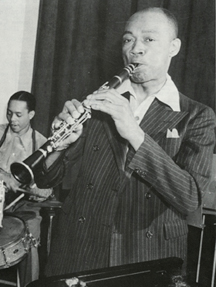 |
| Edmond Hall Image Courtesy Wikimedia Commons |

Subscribe to:
Posts (Atom)