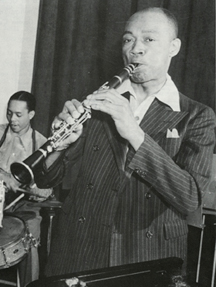
Showing posts with label Edmond Hall. Show all posts

Wednesday, January 29, 2020

100 Jazz Tunes Everyone Should Hear (#19) Edmond Hall

#19 - Besame Mucho - Edmond Hall - 1944

I hate it when a recording is so stiff you can hear how many music stands are in the studio. None of that junk here. Every music stand probably banned within a five mile radius.


This is not a comprehensive list, nor is it representative of the "most important" or "best." Instead, following Duke Ellington's adage that the greatest music and musicians are "beyond category", I'm starting 2020 by sharing 100 jazz tunes I feel everyone should have the chance to hear--really just tunes and performances that I love. ]

Wednesday, January 8, 2014

The Edmond Hall Sextet * Rompin in '44 * The Complete Session * Circle Records


Few windplayers had as immediately identifiable a sound as Edmond Hall. Gritty, warm, earthy, by turns biting and tender, he was a stellar sideman--perhaps best remembered today for his tenure with Louis Armstrong's All-Stars. He'd be even better remembered today had he taken Duke Ellington's offer to replace Barney Bigard in the early '40s. Instead, he stayed with Teddy Wilson's group at New York's Café Society. This was, for Hall, an artistic decision, and ultimately one we can all be glad he made. According to Frank Driggs, who wrote the liner notes to the album reviewed here, Hall considered playing with Wilson the zenith of his career. He wasn't the only jazz clarinetist to feel strongly about Wilson's playing, though, and when Benny Goodman managed to convince Teddy to return to his band for another stint, Hall was left to lead his own group.

A New Orleans native, Hall maintained the traditional front line of trumpet, trombone, and clarinet, but with a twist: instead of playing NOLA style polyphony, with the trumpet taking the vocal lead, he tended to mute the trumpet for color, as Artie Shaw had done with his Gramercy 5, and work from the type of head arrangements that both the Gramercy 5 and the Benny Goodman Sextet favored. The end result is something rare and exceptional: Hall's New Orleans "talking" quality fused with streamlined swing.  The group played the Café Society and, brilliant as they were, struggled to record. Ultimately, they landed only one date: December 4, 1944. Hall didn't waste his opportunity: during that session he laid down no less than three classics of the jazz clarinet canon--"Caravan," "Besame Mucho," and "The Man I Love." While many other clarinetists have successfully recorded these numbers, none have surpassed Hall's depth of soul and originality.

The session took place in New York City, under the supervision of Milt Gabler of World Broadcasting Systems. Hall's band at the time was comprised of Irving Randolph on trumpet, Henderson Chambers on Trombone, Ellis Larkins on piano, Johnny Williams on bass, and Art Trappier on drums. They had from 3 to 6 p.m. During that time, they recorded the following numbers:


Opus 15
The Sheik of Araby (four takes)
Night and Day (two takes)
I Want To Be Happy
The Man I Love (a false start and two takes)
Rompin' in '44 (a false start and three takes)
Caravan (three takes)
Besame Mucho (a false start and one brilliant take)
Face


For some unknown, blessed reason, in 1983 Circle Records released the entire recording session on LP [CLP-52], though it has not, to my knowledge, been rereleased.  This was perhaps the most important session of Hall's career as a leader. He was surrounded by sympathetic musicians of a high caliber, especially the brilliant Ellis Larkins on piano. The Circle disc contains all incomplete takes, false starts, and unissued takes--giving us a window into Hall's creative approach (his opening improvisation on "The Sheik of Araby" for instance, was carefully worked out before the session. As Duke Ellington once pointed out, the emphasis on coming up with solos on the spot is perhaps exaggerated--whether one comes up with a solo a day before or a second before, the important thing is to have come up with it).

This recording has been long out of print, and is very difficult to obtain.

For historic value and brilliance of material, this gets a top rating of Five Good Reeds.


File:Cafe Society'.jpg
Image courtesy of Wikimedia


Tuesday, March 12, 2013

Edmond Hall Live at Club Hangover * 1954


Like 1938, the year of Benny Goodman's Carnegie Hall triumph and Artie Shaw's ascendancy to national prominence, the year 1954  is a major benchmark for jazz clarinet. Shaw's massive final recordings project took place during the first half of that year, ultimately overshadowing all other performances. But tucked away in that history, on August 7th and 14th, recordings were made of broadcasts from Club Hangover in San Francisco of the Ralph Sutton Quintet, with Edmond Hall on clarinet.

The recordings aren't ideal--neither the microphone placements nor the acoustics of the club are particularly inspiring, especially when compared to some of the great live jazz recordings from that era in venues such as the Village Vanguard or the Blue Note. But they are clean, and obviously of equal or better quality as the earlier swing era live checks from the Madhattan Room and elsewhere.

Considering those Edmond Hall served with as a sideman (he was Louis Armstrong's go-to clarinetist for years) and the pianists he'd recorded with (Teddy Wilson and Eddie Heywood among others), this group is much more humble. Ralph Sutton was a solid jazz pianist of the old stride school, and Clyde Hurley a very good trumpet man--all the players on these dates were the "real deal" among musicians--but it would have been impossible for even excellent players to rival the legends on Hall's resume.

Having said this, jazz is not like classical music. The best recordings are not invariably done by the top technical players, and the music, being an exercise in active, communal creativity rather than primarily concerned with reproducing someone else's musical thought, cannot always be well judged by personnel. Armstrong himself often worked with inferior sidemen, as did Sidney Bechet. Shaw and Goodman's recordings are filled with performances by sidemen who never sounded as good afterwards--they were often lifted to greatness by those around them. Duke Ellington's band, despite having brilliant players like Johnny Hodges, Ben Webster, and many others, was always more than the sum of it's parts technically.

Like great basketball players, jazz musicians are often best judged by how they improve the players around them. That this recording provides such a good example makes it indispensable. In many ways, it strikes the listener as an average professional jazz gig from 1954--and therefore a valuable contrast to the pellucid masterpieces of the Shaw Gramercy 5 recorded only months earlier. The gigs contain a laundry list of war horses still on bandstands today: 'St Louis Blues', ' I Got Rhythm', 'Honeysuckle Rose', 'Between the Devil and the Deep Blue Sea', and more. The style is a loose, natural fusion of swing, New Orleans, and boogie woogie--a type of lingua franca, catch all "jazz" style for that era (soon, this style would be considered 'traditional', as bop and other aspects of modern jazz entered the mainstream). Edmond Hall is such a powerful presence on these numbers that he seems the musical leader of the group, though because of his firm New Orleans roots, is so committed to ensemble that he stays within the groups parameters, lifting the level of inspired play for all. Clyde Hurley's trumpet solo on 'Black and Blue', for instance, delivers such powerful soul tonally, that the listener doesn't care who is playing or where: we're just grateful.

Edmond's sound is not well captured here. There are many potential reasons for this, ranging from poor microphone placement to a bad reed. But it doesn't matter. In fact, it's probably better that he doesn't sound anywhere near his best self on this recording: we get to hear what a musician like Hall can accomplish in less than perfect conditions.

This recording is one of my personal favorites. The sound isn't great, but in some ways it's more honest than studio recordings are--and getting to that level of reality can become addictive in it's own way. In fact, it was because of recordings like this that I decided to release our 'Bootlegs from the Bop Stop' CD last year, so you could say that this album had a permanent impact not only on my playing, but my conception of what makes a great album.


Replace this image Ed Hall Solo 1956.jpg
Edmond Hall
Image Courtesy Wikimedia Commons


Thursday, December 20, 2012

Jazz Clarinet Autobiographies: an Overview

Although most of them are out of print, jazz clarinetist are startlingly well represented by highly informative autobiographies--books that are more than marketing hype, and give a real look into the lives and thoughts of the musicians who wrote (or, more often, co-wrote) them.

In my opinion the most important of these books, and a literary work of art in its own right, is Sidney Bechet's Treat it Gentle.  Bechet's book was compiled from interview recordings and edited by a team of writers, among them Joan Reid, Desmond Flower, and the poet John Ciardi, who is still well known for his masterful translation of Dante's Divine Comedy. The work was so well done that Bechet's voice comes through almost as clearly and profoundly as his playing did. This book, which Nat Hentoff called the "most valuable and moving of all jazz biographies" ought to be required reading somewhere--at the very least among all jazz musicians.

Another brilliant, if uniquely odd and idiosyncratic book, is Artie Shaw's The Trouble with Cinderella. This book is unfortunately out of print--and the Ebay prices are climbing.

Benny Goodman's The Kingdom of Swing, published at the height of his popularity in 1938, would seem by context a fluff piece meant to capitalize on music sales, but it isn't. Instead, Benny's self-portrait reveals a side of him not often mentioned by contemporary commentators. In the beginning, especially, it details his family's struggles through poverty, radiating the warmth of that large family, while always focusing on the music and what it meant to him. Like Benny's sound, it is both warm and hard edged, simultaneously. Benny's book has been out of print for a very long time, and can be quite difficult to find.

In 1972, Pete Fountain published his memoir, A Closer Walk,  which reads like his music sounds: a upbeat party, with some heartfelt blues, to be sure, but a whole lot of brightness. As of this writing, the only copy available on Amazon is selling for about $100.

Two other important autobiographies were published posthumously: Barney Bigard's With Louis and the Duke and Woody Herman's The Woodchopper's Ball. These books, while slim, give invaluable insights to the men and their era.

Finally, Bill Russell's volume, New Orleans Style, deserves mentions, as it includes brief autobiographical sketches of Omer Simeon, Edmond Hall, Raymond Burke, and Lawrence Duhe.

I'll be giving more detailed reviews of these books in the near future--interested readers will want to get copies while they are still available. This is an endangered part of our jazz heritage.


Wednesday, July 4, 2012

Pete Fountain for DownBeat Hall of Fame

Many readers of The Jazz Clarinet will probably receive their issue of DownBeat this week, as I did a couple of days ago. It's loaded with interesting stuff this month, including the 60th annual critics poll. Page 38 features a list of those in the DownBeat Hall of Fame.

Clarinetists are well represented, so we have no reason to complain. According to my quick scan, they are the following, in the order they were inducted:

Benny Goodman (1957)
Sidney Bechet (1968)
Pee Wee Russell (1969)
Woody Herman (1976)
Johnny Dodds (1987)
Artie Shaw (1996)

Since the institution of the DB HoF, at least one clarinetist has been inducted every decade--until recently! That means we have to get mobilized, people. There are many clarinetists who deserve to be on this list, including Edmond Hall, Irving Fazola, Omer Simeon, and others. But for me the most glaring omission is Pete Fountain, who was the face of jazz clarinet to the public at large for several decades.

The sad fact is that many jazz fans, especially those born (like myself) after 1970, have never had the opportunity to hear a vast amount of the the great jazz Pete produced from 1959 through the '60s. Albums like The Blues, Live at the Bateau Lounge, Pete's Place, New Orleans after Midnight, and Pete Fountain Day have plenty of great jazz in them. In fact, they tend to highlight what few realize was the genius of Pete Fountain--an ability to take New Orleans jazz and blend it with other styles, moving it forward while inviting others in. Moreover, he helped revitalize the New Orleans jazz scene at a time when it was in danger of disappearing.

Too often great players receive their recognition after their deaths. Pete Fountain is still with us, though he is retired from playing. We have an opportunity.

I'm not sure how to get Pete "on the ballot" so to speak, but let's get this idea circulating, so that critics and fans alike will remember the contribution of one of jazz history's greatest showmen, and one of jazz clarinet's greatest innovators and virtuosos.


Thursday, June 28, 2012

Ten Essential Jazz Clarinet Recordings (5)

5. Edmond Hall * Profoundly Blue

In a rare case of mutual admiration among jazz clarinetists, Benny Goodman once referred to Edmond Hall as his favorite hot jazz clarinetist; a compliment which was reciprocated by Hall. It's difficult to appreciate this statement today. Benny had heard his style flooded by a sea of imitators throughout his career (even now there are plenty riding the Benny train). At least one of the players on this list was an admitted imitator of Goodman, in part: many of Pete Fountain's standard gig numbers were drawn directly and almost without alteration from Benny's versions. Pete never hid this influence, and it doesn't detract from his own unique approach, though it does demonstrates the dominance of Goodman's approach.

When it came time for the King of Swing to endorse another player, he chose one of the most original in the history of jazz: a New Orleans clarinetist known for his work with traditional groups (including Louis Armstrong, with whom he is most associated), yet who branched out into the High Romantic Era of Swing Clarinet, allowing himself to be influenced by Goodman and Artie Shaw.

It's this combination that makes Hall so indispensible, and my favorite of the New Orleans players. He managed to take that NOLA talking style of playing, and advance it beyond classic into romantic era jazz, giving us something profoundly different from those who came before him, yet with the same warmth.

Every time Hall plays, heat seems the result--a sweltering, humid, sauna of sound. Profoundly Blue is an excellent compilation album, and worthy introduction to his work.


Wednesday, June 27, 2012

CD Review: Illustrious Clarinetists of Jazz

This compilation, released on the Jazz Legends label in 2004, and apparently compiled by Scott Yanow who also contributes excellent liner notes, is a must for anyone interested in jazz clarinet. It's by no means comprehensive, but Yanow and crew managed to fit 21 different jazz clarinetists onto one disc. For many, this disc will undoubtedly serve as an introduction to important players such as Jimmy Noone, Omer Simeon, and Edmond Hall.

It's hard to argue with the selections, as variety of clarinetists has rightly taken precedence over demonstrations of artistic range. I was happy to see Woody Herman's 'Chip's Boogie Woogie', Artie Shaw's classic 'Smoke Gets in Your Eyes' and the foundational 'After You've Gone' recorded by Benny Goodman in July of 1935. But the real treats for me were the ones I hadn't heard before, especially Buster Bailey's wild novelty number 'Man With A Horn Goes Berserk' from 1938. 'Berserk' is 2 minutes 29 seconds of virtuosic frenzy--and as some of the phrases seem to have worked their way into Artie Shaw's later 'Concerto for Clarinet', there is some musicological interest here as well.

I was delighted to hear such players as Tony Scott, Joe Marsala, and the all but forgotten Swedish bop player, Stan Hasselgard. Really, this a remarkable set.

My one negative criticism is the cover photo of Sidney Bechet, playing a soprano sax, and as though this isn't bad enough, they repeat the image three times--one time reversing the photo!

Still, this is a compilation not to be missed.