
It's not often that a newly refurbished, high quality mid century instrument falls into your lap for a test-drive, but that's precisely what happened to me this week. Local Clevelander Patrick Price, who purchased this vintage 1966 Buffet R13 for his daughter, wanted to know what he had, and what I felt of it's value as clarinet. After talking with Patrick for just a few minutes, it was clear that he had done his research and knew the market value of the horn -- what he wanted to know was more of how good an instrument it was, and what this clarinet could accomplish in terms of expressive range.
Anyone who knows me as a clarinetist knows that I'm a bit of a partisan -- I am devoted to the old Selmer large bore sound and concept, and lament this era of clarinet manufacturing, considering it a kind of Babylonian captivity for those of us who resist the polycylindrical bores that took over the Parisian scene in the 1950s and '60s. If you know me a little better than that, you also know I played R13s for about a decade, and was frustrated by them.
With all of that squarely in mind, I can tell you unreservedly that this instrument is an absolute gem. It has everything you'd want from the Buffet concept: a big, rich tone from the chalumeau and clarion. The altissimo isn't as strong as you'll get on a Selmer or Boosey & Hawkes, but the Buffet concept is different: it tends to become finer and less broad as it reaches the pinnacle of the natural range. This one's sound had a fairly perfect, Buffet-style taper as it got to double C. Most importantly, the timbre didn't drastically change between registers - it held very nicely.
I've often been critical of polycylindrical bores for clumsiness over the "break" of the clarinet -- pointing out that often the player's voicing has to change to maintain pitch and timbre, making technical passages more difficult to phrase musically. This clarinet presented no such problem.
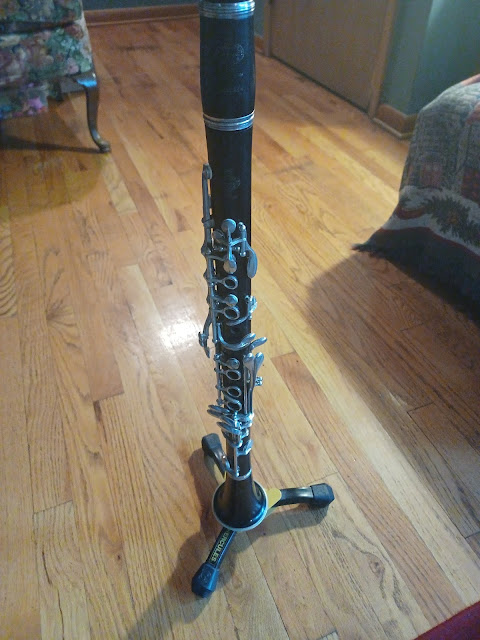 |
| 1966 Buffet R13 |
I played quite a bit of jazz on this instrument today, and then some orchestral excerpts. It can certainly be used as a jazz horn, if that's what the player wants. It has good volume, power, and flexibility. It's growling potential isn't as pronounced as one can get on a Selmer, and it doesn't have as wide a timbral range as my 1955 Selmer Centered Tone, but then again, not much does. I can imagine a player being very successful using it for modern jazz, which tends to have a more classical approach and more restrained sound palette.
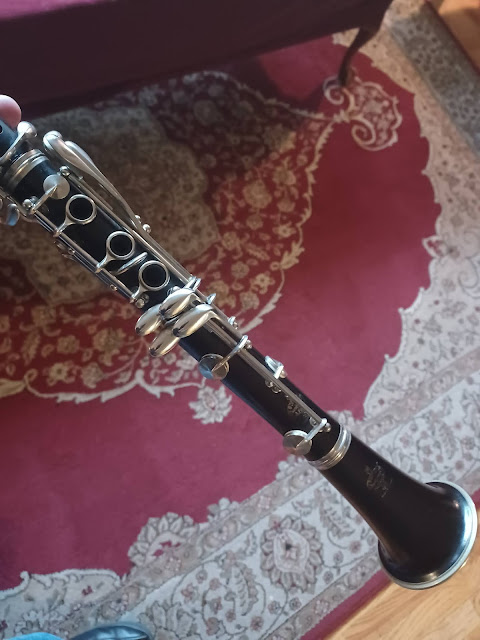 |
| 1966 Buffet R13 |
Where this horn excelled, though, was in the orchestral repertoire. The Buffet R13 was, after all, the instrument of choice for classical masters such as Franklin Cohen, Robert Marcellus, Harold Wright, Stanley Drucker, and so many others. I couldn't help playing some Brahms and Beethoven on it, and when I did this horn really showed it's strengths. The sound had a halo of warmth; a buoyancy and hovering ability that (much as I love them) my Selmers just don't have.
This clarinet was newly refurbished and therefore needs to be played for a few weeks before the sound will truly blossom--the pads need to set properly and wear in a bit. When it does, it will be even more gorgeous than it is now.
What are we to make of the story that Bud Shank owned this at one time? From what Patrick Price told me about it, I believe it was. It's impossible to prove without actual papers, etc., to that effect, but the story seems credible to me. Regardless, his daughter has at her disposal a mid-century beauty, the likes of which they just don't make anymore, in my opinion. May it take her to the heights of musical expression.
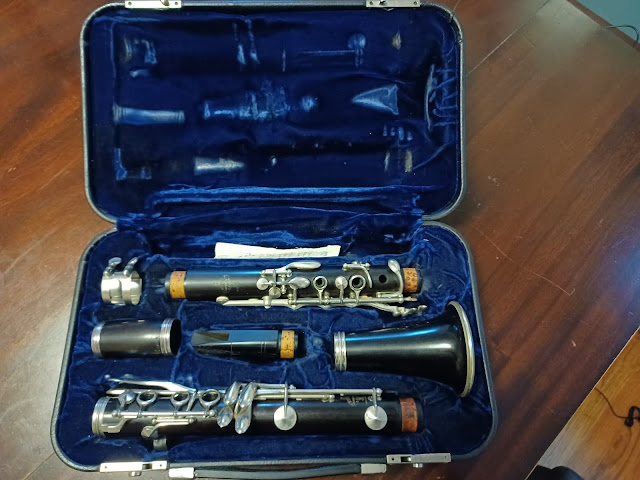 |
| 1966 Buffet R13 |
